Mostrando entradas con la etiqueta Ethics 13-14. Mostrar todas las entradas

14 jul 2016

Liberalism and Communism - Locke, A. Smith, Marx

Clic on the flag for the Galician version

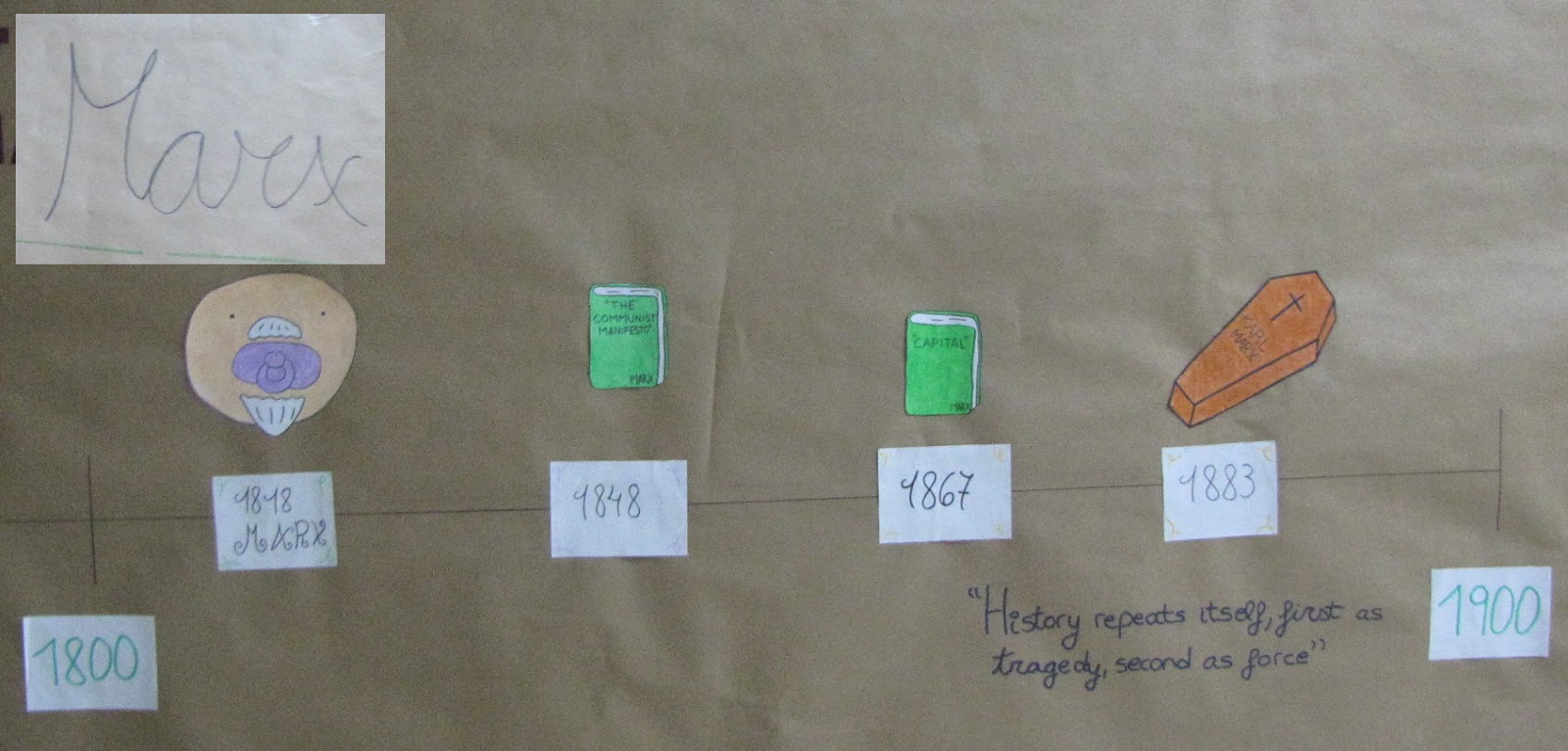
This is our culminating task for the 3rd term: a timeline of the lives of John Locke, Adam Smith and Karl Marx (1600 - 1900).


John Locke (1632 - 1704) was the father of political liberalism. He took part in the Glorious Revolution (1689) and wrote Two Treatises of Government to justify it. He went to the Netherlands to write them because his life was in danger in England (Click on the images to enlarge them).


Adam Smith (1723 – 1799) wrote The wealth of nations (1776), starting the economic liberalism. It was supposed to make people rich, but it made the rich, richer, and the poor, poorer. This is why liberalism was criticized by communism.


Karl Marx (1818 - 1883) wrote the Communist Manifesto (1848). He explained that the liberal society where everybody would like to live, was impossible under a capitalist economy.


Making of
This is how we made the mural.
First, we collected information.


Then, we drew and painted the images.

Finally, we cut them out, pasted them on the mural and hung it on the corridor wall.


27 jul 2014

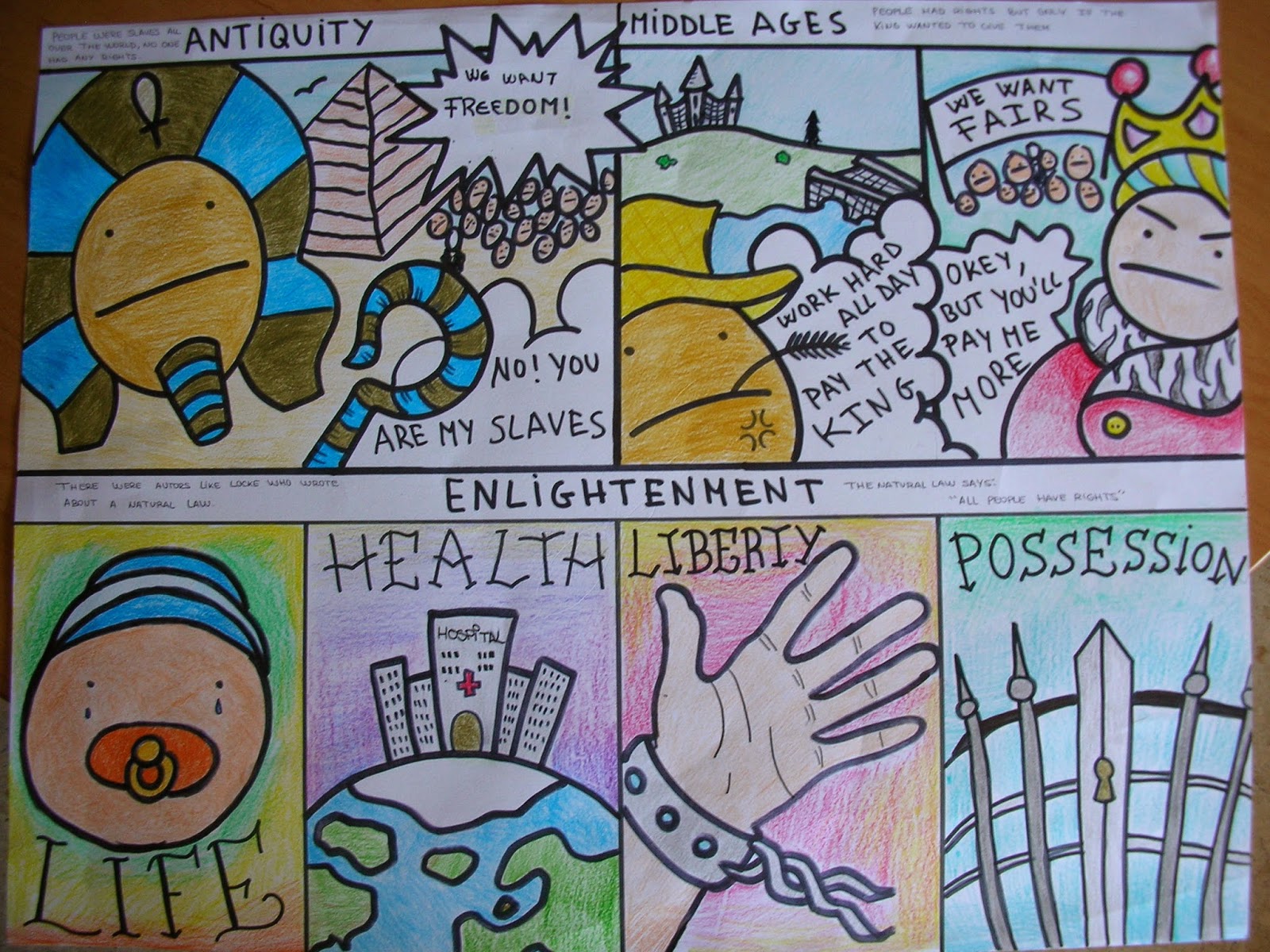
The natural law - A comic strip commentary on a John Locke's text

The state of nature has a law of nature to govern it, which obliges every one: and reason, which is that law, teaches all mankind, who will but consult it, that being all equal and independent, no one ought to harm another in his life, health, liberty, or possessions: for men being all the workmanship of one omnipotent, and infinitely wise maker; all the servants of one sovereign master, sent into the world by his order, and about his business; they are his property, whose workmanship they are, made to last during his, not one another's pleasure: and being furnished with like faculties, sharing all in one community of nature, there cannot be supposed any such subordination among us, that may authorize us to destroy one another.

John Locke, 1689

1. Understanding the text
In order to make a commentary of this text we selected the most important words and ideas:

Words: Law of nature, Reason, Maker 

The natural rights are: life, health, liberty and possessions. We call then now Human Rights and we studied them during the 1st term.
There cannot be supposed any such subordination among us, that may authorize us to destroy one another. Thomas Hobbes thought that life and possessions belonged to the king.
Men were made by one omnipotent, and infinitely wise maker. We call this maker God.

2. Historical context

For a long time people didn´t have any rights.
Thomas Hobbes (1651) said that people had rights but only if the king agreed.
John Locke (1689) said that all people have rights and they don't have to ask the king. He had to run away from England and publish his book in the Netherlands.
The UN (1948) adopted the Universal Declaration of Human Rights. People recognise each others rights, without any reference to God.

3. Our commentary

When we wanted to write our commentary we found that it was very difficult to write the sentences. Then we decided to make our commentary as a comic strip. Here's the result:


4. Making of

24 sept 2013

First task for Ethics 2013-14

Welcome to the academic year 2013-14.
This is our first task of the year: Who am I?
We are going to use the web tool BITSTRIPS. Follow these steps:
1. Go to the site Bitstrips for schools.
2. Click on "LOG IN".
3. Enter your class code, (Ethics4) and click on "GO".
4. Select your name.
5. Create your password and type it in (Write it in a sure place so you do not forget it!!!).
6. Enter the application and follow the instructions to create an avatar and a comic strip.

7. Any other instructions will be given to you by the teacher. Listen to him!!!
We hope you enjoy this subject!!!